Problem guide
Car Won't Start? Start With the Symptoms
A car that won't start isn't one fault — it's several different faults that share one outcome. What the vehicle does when you turn the key narrows the possibilities down considerably, which is why the first question is always about the exact symptom.
This guide is for drivers in Paisley and nearby Renfrewshire trying to work out what's happening before deciding on the next step.
Match the symptom
Nothing or almost nothing happens
- No dashboard lights at all — often battery, main connections or a main supply fault
- Dashboard lights but no crank — starting circuit, immobiliser, or a very weak battery
- A single click when turning the key — solenoid, supply or battery condition
- Rapid clicking — usually not enough current reaching the starter
It turns over or starts sometimes
- Engine turns over but does not fire — ignition, fuel, sensors or engine management
- Starts with a jump but goes flat again — charging fault or a drain, not just the battery
- Intermittent starting — connections, relays, switch or an early-stage failure
- Starts sometimes but not others — often heat, damp or a marginal connection
What may be behind it
Possible causes vary with the symptom, and more than one may be involved:
- Battery condition or state of charge
- Loose or corroded battery terminals
- Charging-system fault leaving the battery low
- Starter motor or starter circuit fault
- Immobiliser or key recognition issue
- Wiring, relay or fuse fault
- Sensor or engine-management problem
- Mechanical or fuel-related fault
Not every no-start is electrical
An engine that cranks strongly but won't run might have a fuel, ignition or mechanical problem. Electrical testing is still worthwhile because it either finds the cause or rules the electrics out — but the fault can't be assumed to be electrical from the start.
Don't keep trying to start the car if there's smoke, a burning smell, damaged wiring or unusual heat around the battery or electrical system.
What testing at the vehicle can establish
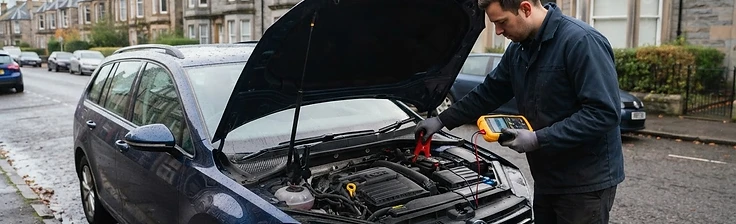
- Whether the battery can supply cranking current
- Whether voltage is reaching the starter when the key is turned
- Whether earths and main cables are sound
- Whether the charging system has been keeping up
- Whether stored fault codes point to a system
- Whether the immobiliser is allowing the engine to run
- Whether fuses and relays in the circuit are healthy
- Whether the fault is likely to be outside the electrics
What happens next
Where the cause is found and access allows, some repairs can be done at the vehicle. Others need parts, more time or workshop facilities, and occasionally recovery is the sensible next step. Either way, you should know what was measured and why.
Where this is available
We cover Paisley and the surrounding Renfrewshire area. Whether a mobile visit works depends on where the car is, what the fault is, and what's available at the time.
FAQs
Frequently asked questions
Can you diagnose a car that will not start?
Often, yes. What the car does when the key is turned guides the testing, and battery, starting circuit and charging checks can usually be done where the vehicle is parked.
My car starts after a jump but goes flat again — is it the battery?
Possibly, but a charging fault or a drain while parked will produce exactly the same pattern, so the whole system should be tested rather than only the battery.
Should I keep trying to start it?
Repeated attempts can flatten the battery further and are unwise if there's any smell of burning, smoke or heat. Better to describe the symptoms and stop.
Related pages
Next step
Tell us what the car is doing
The first step is understanding what's happening. Give us a call or send over the vehicle details and we'll help work out whether a mobile appointment makes sense.
We cover Paisley and the surrounding Renfrewshire area. Whether a mobile visit works depends on where the car is, what the fault is, and what's available at the time.
Phone: 0141 345 1756